Oct 15, 2026
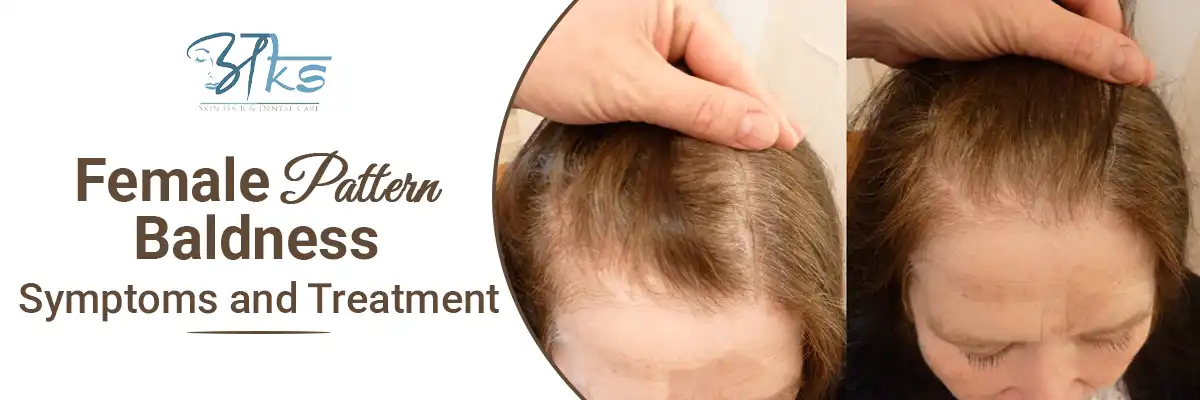
Have you noticed your hair parting getting wider or your ponytail looking thinner than before? Maybe your scalp has started showing through under bright lights. These small changes can be early signs of female pattern baldness.
Hair loss in women doesn't always mean large bald patches. Sometimes, the hair becomes thinner over several years. Many women mistake this for normal shedding until the change becomes noticeable.
Female pattern hair loss can begin in your twenties, although it becomes more common with age. Finding the cause early gives you more treatment options.
Female pattern baldness, also called androgenetic alopecia, happens when hair follicles gradually shrink. As the follicles become smaller, they produce thinner and shorter strands.
Unlike men, who often develop a receding hairline, women usually notice thinning around the middle parting and crown.
The condition often runs in families. Hormones and age can also play a role.
Although treatment cannot promise to restore every lost strand, starting early may slow further thinning and improve hair density.
The early signs of alopecia in females can be easy to miss. Hair may still grow, but individual strands become finer.
Watch for these changes:
Hair thinning at crown female complaints often begin with reduced volume rather than sudden shedding.
If you're wondering, "Am I balding?", compare photographs taken several months apart. Changes in your parting can help you spot gradual thinning.
Genetics is one of the main reasons women develop pattern baldness. If your mother or grandmother had thin hair, you might be more likely to.
Hormones also affect hair growth.
Androgens, such as dihydrotestosterone (DHT), may play a role in follicle miniaturisation in genetically predisposed women. However, many women with pattern hair loss have normal hormone levels.
Changes around menopause may make thinning more noticeable.
Other conditions can cause similar symptoms:
Iron deficiency hair loss can occur alongside female pattern baldness, but the two conditions are different.
Doctors use grading systems to understand how far thinning has progressed.
The Sinclair scale describes five stages of hair loss.
Women rarely become completely bald from female pattern hair loss alone.
Yes. Female pattern baldness in 20s can happen, particularly when hair loss runs in the family.
Young women may first notice a widening parting, reduced volume, or more scalp visibility.
However, at this age, hair loss can also be due to nutritional problems, hormonal changes or stress.
The female pattern of hair loss associated with stress tends to cause increased shedding all over the scalp rather than thinning gradually around the parting.
A dermatologist can examine your scalp and determine if you have pattern baldness or something else.
Treatment depends on your age, medical history, and the amount of hair remaining.
Topical minoxidil is commonly recommended for female pattern hair loss. It may slow thinning and encourage some regrowth.
Visible improvement usually takes several months. Continued use is generally necessary to maintain results.
Dermatologists sometimes prescribe medicines such as spironolactone for selected women. These medicines require medical supervision and are unsuitable during pregnancy.
PRP Treatment involves collecting blood, separating platelet-rich plasma, and injecting it into the scalp.
Some women experience improved hair density, although results vary.
GFC Therapy uses growth factors prepared from the patient's blood. It may help some people with thinning hair, but research remains limited.
A Hair Transplant may suit selected women with stable hair loss and enough healthy donor hair.
Diffuse thinning can make transplantation unsuitable, so doctors must examine the donor area carefully.
Don't ignore sudden shedding, bald spots, itching or red scalp. These symptoms may point to another condition.
A dermatologist may recommend blood tests or a closer scalp examination before starting treatment.
Dr. Akhilendra Singh is a PGIMER Chandigarh trained Dermatologist who analyses the hair loss concern at AKS Clinic and discusses the treatment options as per the patient’s condition.
Treatment may slow thinning and regrow some hair, particularly when started early.
It becomes more common after menopause, but younger women can experience it too.
Yes. Low iron levels can contribute to shedding and may require medical treatment.
It is a long-term condition. Treatment can help manage hair loss, but ongoing care is often needed.
Yes. Dermatologists may recommend PRP for selected women after examining their scalp.