Oct 28, 2026
Finding more hair in your shower drain or on your pillow can be worrying. At first, you might ignore it. But when your hairline starts receding or your scalp becomes easier to see, you begin searching for ways to control hair fall.
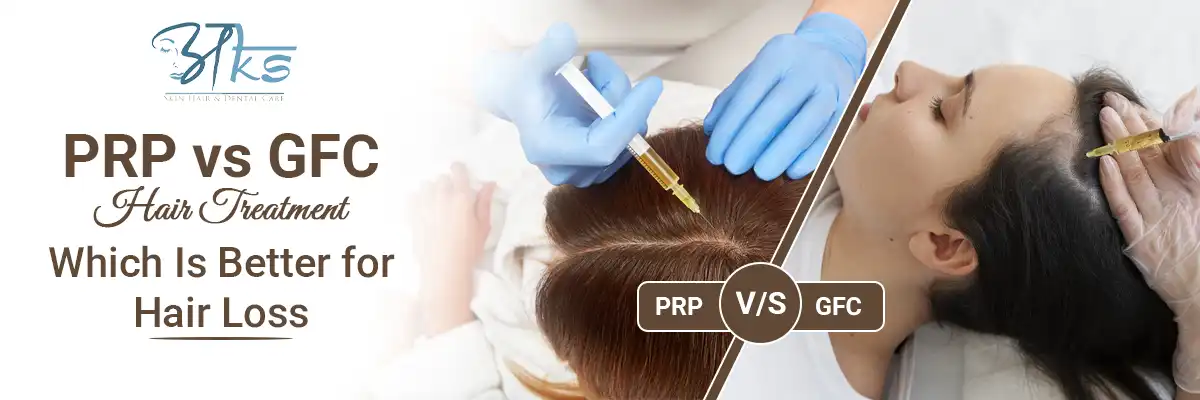
PRP and GFC are two treatments offered for thinning hair. Both involve taking blood from your arm, preparing it, and injecting part of it into your scalp. But they aren't the same treatment, and neither works for every type of hair loss.
The choice between PRP and GFC depends mainly on why you're losing hair and how much thinning has already happened.
PRP has been used for a longer time, especially in patients with male or female pattern hair loss. GFC is another option, but doctors have less research to back up long-term comparisons of its results.
If your hair follicles are still producing hair, these injections might improve hair density. If an area has been completely bald for years, injections are unlikely to bring the hair back.
PRP means Platelet-Rich Plasma. Your blood contains platelets that carry substances involved in healing and tissue repair.
In the PRP procedure, your doctor draws a sample of your blood and places it in a machine known as a centrifuge. The machine separates the blood into different layers. The doctor collects the platelet-rich portion and injects it into the thinning areas.
People usually consider PRP for:
Most people need several appointments. Hair growth takes time, so you shouldn't expect a visible change after one session.
GFC stands for Growth Factor Concentrate.
GFC hair treatment starts with blood draw, just like PRP. However, the doctor uses a special collection kit to separate growth factors released by the platelets.
These growth factors are then injected into the scalp.
The idea is to help existing follicles produce thicker hair. Some patients report less discomfort with GFC, but that doesn't mean everyone will find it painless.
GFC is sometimes advertised as better than PRP. Research hasn't yet proved that claim for all patients.
The biggest difference between GFC and PRP is what goes into the injection.
| PRP | GFC |
|---|---|
| Contains platelet-rich plasma | Contains growth factors collected from platelets |
| Has more published hair loss research | Has fewer published studies |
| Usually costs less | Usually costs more |
| Requires scalp injections | Requires scalp injections |
| May improve hair thickness | May improve hair thickness |
Neither procedure gives an instant result. Your hair needs months to grow, even when treatment works.
If you're wondering PRP or GFC which is better, don't judge them by before-and-after photographs alone.
PRP has more clinical evidence behind it. Some patients develop thicker hair after a series of injections, while others notice little change.
GFC has also been studied, but the evidence remains limited. There isn't enough proof to say it works better for everyone.
Your doctor should first find out whether you have hereditary hair loss, stress-related shedding, or another scalp problem.
For example, someone losing hair because of an iron deficiency may need treatment for that deficiency rather than scalp injections.
The PRP vs GFC cost depends on the clinic, location, preparation kit, and number of sessions.
GFC generally costs more than PRP, although prices vary.
Before booking, ask three questions:
Avoid buying a large treatment package before getting your scalp checked.
PRP and GFC won't reliably grow hair on a scalp where the follicles are no longer working.
For extensive baldness, a hair transplant may be worth discussing. However, transplantation also depends on the amount of healthy donor hair available.
Depending on the patient’s diagnosis and medical history, they may be prescribed medicines like minoxidil or finasteride.
Dr. Akhilendra Singh at AKS Clinic studies hair loss problems and helps patients understand whether PRP, GFC, medicines or hair transplantation can be suitable for their condition.
PRP has more research behind it. GFC may also help, but neither treatment works for everyone.
You may feel mild discomfort during the injections. Pain levels differ between patients.
Doctors often suggest several sessions, followed by a review of hair growth.
GFC may improve thinning hair, but it cannot reliably restore hair in permanently bald areas.
PRP may be suitable for some women with pattern hair loss after a medical examination.